Uncategorized

Voice search optimization
Uncategorized

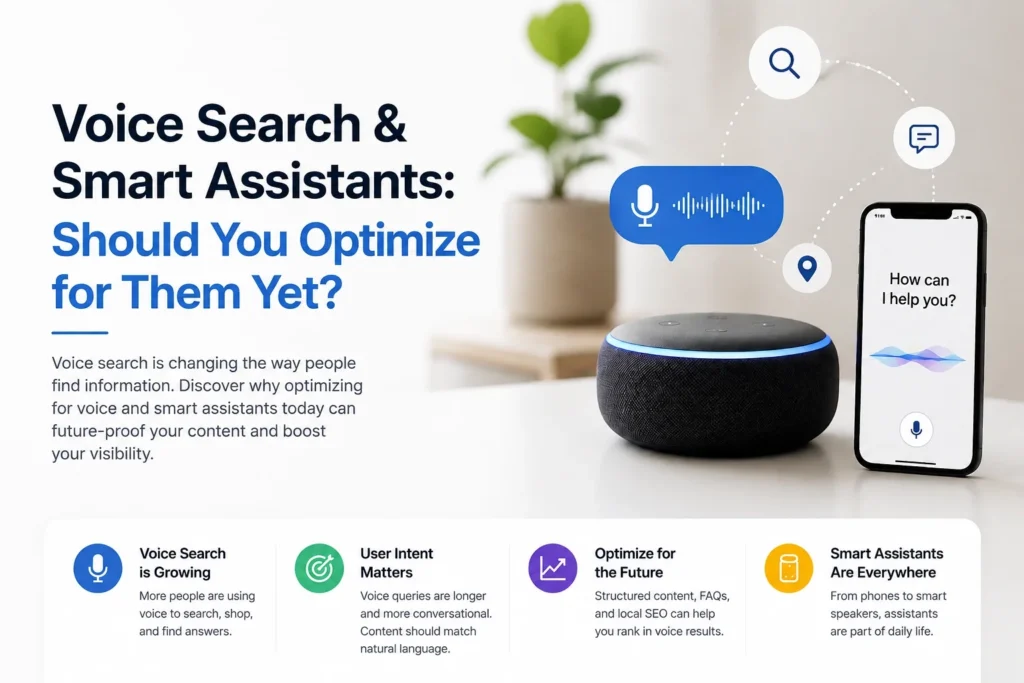
Voice Search & Smart Assistants: Should You Optimize for Them Yet?

Introduction: A Question Marketers Keep Postponing For nearly a decade, marketers have debated whether voice search represents a genuine shift in consumer behavior or merely a novelty that never fully materialized into a dominant search channel. Smart speakers sit in millions of households, voice assistants respond to commands on nearly every smartphone, and yet many businesses still treat voice optimization as an afterthought rather than a core component of their search strategy. Consequently, the question persists: should marketers invest meaningful resources into voice search optimization today, or does this channel remain too immature to justify the effort? This uncertainty stems largely from mixed signals within the industry. While some data suggests that voice queries continue to grow steadily, particularly for local searches and quick informational lookups, actual purchasing behavior through voice remains far less common than through traditional screen-based search. Therefore, before allocating budget and resources toward voice optimization, marketers must examine how consumers currently use voice technology, what practical benefits early adoption might offer, and where meaningful limitations still exist. Understanding How Consumers Actually Use Voice Assistants Before determining whether voice optimization deserves investment, marketers must first understand realistic usage patterns rather than relying on assumptions. Consumers primarily use voice assistants for quick, low-stakes tasks such as checking the weather, setting timers, playing music, or asking simple factual questions. As a result, voice technology has become deeply integrated into daily routines, yet its application to complex research or purchasing decisions remains comparatively limited. Moreover, voice search behavior differs significantly from typed search behavior in terms of query structure. Users tend to phrase voice queries as complete, conversational questions rather than the fragmented keyword phrases commonly used in text-based searches. Consequently, businesses examining their search strategy must recognize that voice queries often reflect a different intent altogether — one rooted in immediate, spoken curiosity rather than deliberate, comparison-driven research. The Local Search Connection: Where Voice Already Delivers Value Among the various applications of voice search, local search stands out as the area where this technology already provides measurable value for businesses. When users ask their smart assistant to find a nearby restaurant, check store hours, or locate the closest service provider, they typically expect an immediate, actionable answer. As a result, businesses with optimized local listings and structured location data often benefit directly from voice-driven discovery. Furthermore, this local search advantage extends naturally to mobile voice searches conducted while users are away from home. Since many voice queries occur in situational contexts — while driving, walking, or multitasking — businesses that ensure accurate, up-to-date local information position themselves to capture this immediate intent. Therefore, marketers prioritizing local visibility should treat voice optimization as a natural extension of existing local SEO efforts rather than an entirely separate initiative. The Limits of Voice for Complex Purchase Decisions Despite voice search’s clear strengths in local and informational contexts, it continues to show significant limitations when applied to complex purchasing decisions. Consumers rarely use voice assistants to compare detailed product specifications, read extensive reviews, or evaluate pricing across multiple options, since these tasks require visual information that voice interfaces struggle to convey efficiently. Consequently, businesses selling complex or considered-purchase products should not expect voice search to drive substantial direct conversions in the near term. In addition, the audio-only nature of most voice interactions limits the amount of information a user can absorb during a single query. Unlike a search engine results page, which displays multiple options simultaneously, voice assistants typically present only one or two results before requiring further interaction. As a result, businesses operating in competitive categories face a winner-take-most dynamic, where securing the single voice-recommended answer becomes disproportionately valuable compared to ranking anywhere else. Featured Snippets and the Voice Search Connection Interestingly, one of the most practical entry points into voice optimization already exists within traditional SEO practices: featured snippets. Since many voice assistants pull their spoken answers directly from featured snippet content, businesses that successfully secure this position on search engine results pages often gain visibility within voice search results as a natural byproduct. Therefore, marketers seeking a low-risk way to begin voice optimization should first focus on earning featured snippet placement for relevant, question-based queries. Moreover, structuring content specifically to answer common questions concisely and clearly increases the likelihood of being selected as a voice response. This involves anticipating the natural language questions customers might ask, then providing direct, well-organized answers near the beginning of relevant content. Consequently, businesses that already prioritize clear, question-oriented content structures find themselves well-positioned for voice visibility without requiring an entirely separate content strategy. Structured Data: The Technical Foundation Voice Assistants Rely On Beyond content structure, technical implementation plays a critical role in determining whether voice assistants can accurately interpret and surface a business’s information. Structured data markup, commonly implemented through schema.org vocabulary, helps search engines and voice assistants understand the context and specific details of a webpage’s content. As a result, businesses that implement comprehensive structured data increase their chances of being accurately represented in voice search responses. Furthermore, structured data becomes particularly important for businesses with location-specific information, such as operating hours, addresses, and service offerings, since voice assistants frequently rely on this data to answer local queries accurately. Therefore, marketers considering voice optimization should prioritize technical SEO fundamentals, ensuring that structured data remains accurate, comprehensive, and regularly updated, since outdated information can lead to voice assistants providing incorrect answers to potential customers. Evaluating the Cost-Benefit Equation for Different Business Types Given the varying strengths and limitations of voice search, businesses must evaluate whether optimization efforts align with their specific industry and customer behavior patterns. Local service providers, restaurants, and businesses with straightforward, frequently asked questions tend to benefit most from voice optimization, since their content naturally aligns with common voice query patterns. Consequently, these businesses should consider voice optimization a reasonably high priority within their broader SEO strategy. Conversely, businesses selling complex, high-consideration products or services may find that voice optimization offers limited immediate return relative to other marketing investments. Since

Dark Data in Marketing
Uncategorized

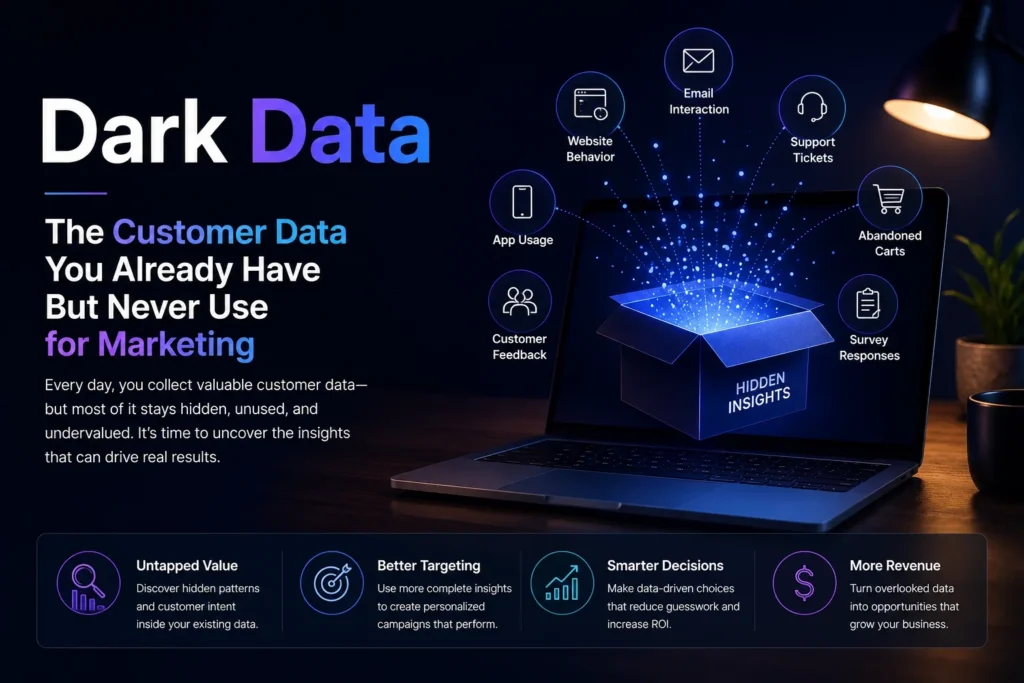
Dark Data The Customer Data You Already Have But Never Use for Marketing

Introduction: The Data Hiding in Plain Sight Every organization collects far more customer data than it actively uses. Support tickets, chat transcripts, abandoned form fields, app usage logs, return requests, and even the metadata attached to routine transactions accumulate silently in the background. This overlooked information is commonly referred to as “dark data” — a term borrowed from the concept of dark matter, since it exists in significant volume yet remains largely invisible to those who could benefit from it most. Marketers, in particular, tend to focus on data that arrives through familiar channels: email open rates, website analytics, and CRM records. However, this narrow focus causes organizations to overlook a vast reservoir of insight sitting untouched in customer service systems, product logs, and internal databases. Consequently, businesses that fail to investigate their dark data are missing opportunities to understand customer behavior more deeply and to personalize marketing efforts more effectively than their competitors. Why Dark Data Accumulates Without Being Used Dark data does not accumulate by accident; rather, it results from structural and organizational patterns common to most businesses. Different departments typically collect and store data independently, and marketing teams rarely have direct access to systems managed by customer support, product development, or operations. Consequently, valuable insights become siloed within departmental boundaries, preventing marketers from ever discovering their existence. In addition, many organizations lack the internal processes necessary to systematically review or tag unstructured information for future use. Since analyzing free-text data requires natural language processing tools or manual review, teams often deprioritize this work in favor of more immediately actionable metrics. Therefore, dark data continues to accumulate simply because no clear ownership or workflow exists to extract value from it, even though the underlying information could meaningfully inform marketing strategy. Customer Support Interactions as an Untapped Resource Among the richest sources of dark data are customer support interactions, including chat logs, support tickets, and call transcripts. These records often contain explicit statements about customer frustrations, unmet needs, and product expectations — insights that rarely surface through traditional market research methods. As a result, marketing teams that gain access to this information can identify recurring pain points and messaging opportunities they would otherwise miss entirely. Moreover, customer support data frequently reveals the specific language customers use to describe problems and desired outcomes. Since this language reflects authentic customer sentiment rather than marketer-crafted terminology, incorporating it into campaign messaging can significantly improve resonance and relatability. Consequently, businesses that systematically mine support interactions for recurring phrases and themes often discover more effective ways to communicate value propositions than those relying solely on internal assumptions about customer needs. Product Usage Logs and Behavioral Signals Another substantial source of dark data lies within product usage logs, particularly for companies offering software or digital services. These logs capture granular details about how customers interact with a product, including which features they use frequently, which they ignore, and where they encounter friction or abandon tasks altogether. Marketing teams rarely access this information directly, yet it holds tremendous potential for shaping targeted campaigns and lifecycle messaging. Additionally, behavioral signals embedded in usage data can reveal early indicators of churn risk or upsell opportunities. For instance, a noticeable decline in feature usage might signal disengagement long before a customer formally cancels a subscription, while consistent use of advanced features might indicate readiness for a premium upgrade. Therefore, integrating product usage data into marketing workflows allows for more precise segmentation and timely intervention, rather than relying solely on demographic or purchase-based criteria. Abandoned Forms and Incomplete Transactions Abandoned forms and incomplete transactions represent another frequently overlooked category of dark data. When a customer begins filling out a form, initiates a checkout process, or starts a signup flow but fails to complete it, valuable information about their intent and hesitation points remains captured within the system. Unfortunately, many organizations discard this data or fail to analyze it systematically, thereby losing insight into the specific barriers preventing conversion. Furthermore, examining patterns across abandoned interactions can reveal structural issues within the customer journey that broader analytics might overlook. For example, if a significant number of users abandon a form at the same specific field, this pattern likely indicates confusion, technical friction, or a psychological barrier related to that particular data request. Consequently, marketers who investigate this dark data can refine user experience, adjust messaging, and ultimately recover lost conversions that would otherwise remain unexplained. Returns, Refunds, and the Story They Tell Return and refund data constitutes yet another underutilized resource within most organizations. While operations and finance teams typically process this information for logistical purposes, marketing departments rarely examine the underlying reasons customers cite for returning products or requesting refunds. However, this data often contains direct feedback about product expectations, quality perceptions, and messaging accuracy. Moreover, analyzing return reasons in aggregate can reveal discrepancies between how a product is marketed and how customers actually experience it after purchase. If a substantial portion of returns cite unmet expectations related to specific claims made in advertising, this signals a clear opportunity to adjust messaging or product descriptions moving forward. Therefore, incorporating return and refund data into marketing analysis provides a valuable feedback loop that helps align promotional claims with genuine customer experience.  aboodigital.com Breaking Down Silos to Unlock Dark Data’s Value Given the substantial value embedded within dark data, organizations must prioritize breaking down the departmental silos that prevent its discovery and analysis. Cross-functional collaboration between marketing, customer support, product, and operations teams becomes essential for identifying which data sources exist and determining how they can be responsibly integrated into marketing strategy. Consequently, businesses that establish regular communication channels between these departments position themselves to uncover insights unavailable to more siloed competitors. In addition, investing in tools capable of processing unstructured data — such as natural language processing software for analyzing text-based interactions — can significantly accelerate the extraction of actionable insights. Since manual review of large volumes of unstructured data remains impractical at scale, technology plays a crucial role in transforming

Free Trial Length as a Psychological Lever
Uncategorized

Free Trial Length as a Psychological Lever — 7 vs. 14 vs. 30 Days, and Why the Number Itself Sends a Signal

Free Trial Length as a Psychological Lever  Introduction: More Than Just a Countdown When a company decides how long to offer a free trial, it rarely realizes it is making a psychological statement rather than a purely operational one. A trial length is not simply a countdown clock ticking toward a subscription decision; instead, it functions as a signal that shapes how prospective customers perceive the product, the company, and even their own urgency to act. Consequently, the choice between 7, 14, and 30 days carries implications that extend far beyond scheduling convenience.  As competition among subscription-based businesses intensifies, marketers have begun to recognize that trial duration influences behavior in subtle but measurable ways. Therefore, understanding the psychology behind these numbers has become essential for any company seeking to optimize conversion rates, reduce churn, and communicate confidence in its offering. This post examines how each trial length sends a distinct message and explores which approach aligns best with different business models. The Seven-Day Trial: Urgency in Its Purest Form A seven-day trial compresses the decision-making window into a tight, high-pressure timeframe. As a result, users who sign up for a short trial often feel an immediate sense of urgency, since they understand that inaction will quickly result in either a charge or a loss of access. This urgency can be advantageous for companies with straightforward products that users can evaluate quickly, since it encourages fast engagement and reduces the likelihood of prolonged indecision. However, the brevity of a seven-day window also signals something about the company’s confidence — or lack thereof — in its own product. Because users have limited time to explore features, integrate the tool into their workflow, or witness measurable results, this trial length tends to work best for simple, intuitive products rather than complex platforms requiring a learning curve. Consequently, businesses offering seven-day trials must ensure their onboarding process is exceptionally efficient, since every wasted day directly diminishes the user’s opportunity to reach a value-driven decision. @aboodigital.com The Fourteen-Day Trial: The Balanced Middle Ground Fourteen-day trials have become something of an industry standard, largely because they strike a balance between urgency and adequate exploration time. Unlike the seven-day model, this duration allows users to move past initial setup friction and begin experiencing genuine value from the product. As a result, companies offering two-week trials often see higher engagement during the middle portion of the trial period, since users have enough time to establish habits without feeling rushed. Moreover, the fourteen-day window sends a moderate signal of confidence — long enough to suggest the company believes its product can prove its worth, yet short enough to maintain a sense of momentum. Consequently, this trial length works particularly well for products that require a few sessions of use before their value becomes apparent, such as productivity tools or platforms with a modest learning curve. Companies leveraging this model, however, must still design deliberate touchpoints throughout the trial to prevent user disengagement during the middle days, when initial enthusiasm may begin to wane. The Thirty-Day Trial: A Statement of Confidence A thirty-day trial represents the most generous timeframe among the three, and it consequently communicates a strong signal of confidence in the product’s ability to deliver sustained value. Because users have an entire month to explore features, integrate the tool into daily routines, and observe measurable outcomes, this trial length works exceptionally well for complex platforms, enterprise software, or products requiring behavioral change over time. Nevertheless, a longer trial period is not without risk. Since users have abundant time to explore the product, they may also postpone forming a habit around it, resulting in lower urgency and, potentially, lower conversion rates at the trial’s conclusion. Therefore, companies choosing this approach must implement proactive engagement strategies — such as milestone-based prompts, progress tracking, and periodic check-ins — to ensure that users remain motivated throughout the extended evaluation period rather than losing momentum partway through. The Psychology of Perceived Value Beyond urgency and exploration time, trial length also shapes how users perceive the underlying value of a product. A shorter trial can inadvertently suggest that the product delivers value quickly and requires minimal onboarding, which may enhance perceived efficiency for tools designed around simplicity. Conversely, a longer trial can imply that a product offers deep, layered value that unfolds gradually — an impression that resonates well with sophisticated platforms targeting professional or enterprise users. In addition, trial length can influence a user’s perception of a company’s market positioning. A brand offering a brief trial may be interpreted as confident and streamlined, while one offering an extended trial may be perceived as thorough and comprehensive. As a result, businesses must carefully consider not only how long their trial should last, but also what image that duration projects to prospective customers evaluating multiple competing solutions. The Impact on User Behavior and Habit Formation Trial length also plays a critical role in habit formation, since behavioral psychology suggests that consistent engagement over time strengthens the likelihood of continued use. A seven-day trial, for instance, may not provide sufficient repetition for users to develop a routine around the product, whereas a thirty-day trial offers ample opportunity for habitual behavior to take root. Consequently, companies whose products rely on daily or weekly engagement patterns should weigh trial length against the time it typically takes users to form a consistent habit. Furthermore, habit formation directly influences conversion outcomes at the end of a trial period. Users who have integrated a product into their daily workflow are considerably more likely to convert to paid subscriptions, since discontinuing use would disrupt an established routine. Therefore, businesses should align trial duration with the realistic timeframe required for habit formation within their specific product category, rather than defaulting to an industry-standard length without considering behavioral nuance. Aligning Trial Length With Business Model and Product Complexity Given the psychological implications discussed above, businesses must align trial length with their specific product complexity and target audience. Simple, consumer-facing applications with immediate utility

Scroll to Top