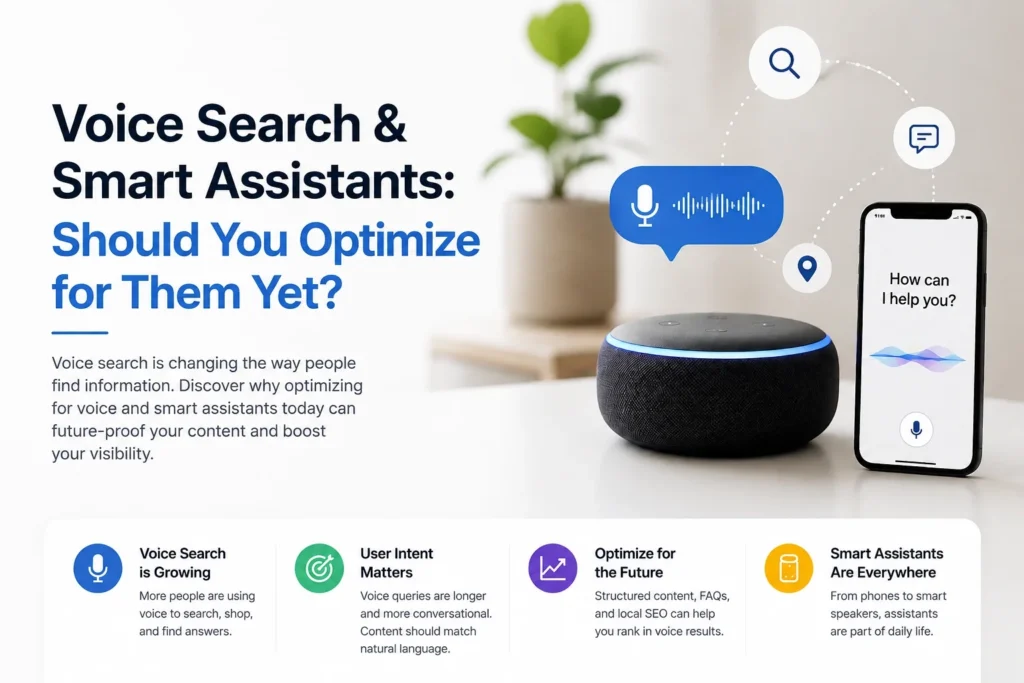
Voice Search & Smart Assistants: Should You Optimize for Them Yet?
Introduction: A Question Marketers Keep Postponing For nearly a decade, marketers have debated whether voice search represents a genuine shift in consumer behavior or merely a novelty that never fully materialized into a dominant search channel. Smart speakers sit in millions of households, voice assistants respond to commands on nearly every smartphone, and yet many businesses still treat voice optimization as an afterthought rather than a core component of their search strategy. Consequently, the question persists: should marketers invest meaningful resources into voice search optimization today, or does this channel remain too immature to justify the effort? This uncertainty stems largely from mixed signals within the industry. While some data suggests that voice queries continue to grow steadily, particularly for local searches and quick informational lookups, actual purchasing behavior through voice remains far less common than through traditional screen-based search. Therefore, before allocating budget and resources toward voice optimization, marketers must examine how consumers currently use voice technology, what practical benefits early adoption might offer, and where meaningful limitations still exist. Understanding How Consumers Actually Use Voice Assistants Before determining whether voice optimization deserves investment, marketers must first understand realistic usage patterns rather than relying on assumptions. Consumers primarily use voice assistants for quick, low-stakes tasks such as checking the weather, setting timers, playing music, or asking simple factual questions. As a result, voice technology has become deeply integrated into daily routines, yet its application to complex research or purchasing decisions remains comparatively limited. Moreover, voice search behavior differs significantly from typed search behavior in terms of query structure. Users tend to phrase voice queries as complete, conversational questions rather than the fragmented keyword phrases commonly used in text-based searches. Consequently, businesses examining their search strategy must recognize that voice queries often reflect a different intent altogether — one rooted in immediate, spoken curiosity rather than deliberate, comparison-driven research. The Local Search Connection: Where Voice Already Delivers Value Among the various applications of voice search, local search stands out as the area where this technology already provides measurable value for businesses. When users ask their smart assistant to find a nearby restaurant, check store hours, or locate the closest service provider, they typically expect an immediate, actionable answer. As a result, businesses with optimized local listings and structured location data often benefit directly from voice-driven discovery. Furthermore, this local search advantage extends naturally to mobile voice searches conducted while users are away from home. Since many voice queries occur in situational contexts — while driving, walking, or multitasking — businesses that ensure accurate, up-to-date local information position themselves to capture this immediate intent. Therefore, marketers prioritizing local visibility should treat voice optimization as a natural extension of existing local SEO efforts rather than an entirely separate initiative. The Limits of Voice for Complex Purchase Decisions Despite voice search’s clear strengths in local and informational contexts, it continues to show significant limitations when applied to complex purchasing decisions. Consumers rarely use voice assistants to compare detailed product specifications, read extensive reviews, or evaluate pricing across multiple options, since these tasks require visual information that voice interfaces struggle to convey efficiently. Consequently, businesses selling complex or considered-purchase products should not expect voice search to drive substantial direct conversions in the near term. In addition, the audio-only nature of most voice interactions limits the amount of information a user can absorb during a single query. Unlike a search engine results page, which displays multiple options simultaneously, voice assistants typically present only one or two results before requiring further interaction. As a result, businesses operating in competitive categories face a winner-take-most dynamic, where securing the single voice-recommended answer becomes disproportionately valuable compared to ranking anywhere else. Featured Snippets and the Voice Search Connection Interestingly, one of the most practical entry points into voice optimization already exists within traditional SEO practices: featured snippets. Since many voice assistants pull their spoken answers directly from featured snippet content, businesses that successfully secure this position on search engine results pages often gain visibility within voice search results as a natural byproduct. Therefore, marketers seeking a low-risk way to begin voice optimization should first focus on earning featured snippet placement for relevant, question-based queries. Moreover, structuring content specifically to answer common questions concisely and clearly increases the likelihood of being selected as a voice response. This involves anticipating the natural language questions customers might ask, then providing direct, well-organized answers near the beginning of relevant content. Consequently, businesses that already prioritize clear, question-oriented content structures find themselves well-positioned for voice visibility without requiring an entirely separate content strategy. Structured Data: The Technical Foundation Voice Assistants Rely On Beyond content structure, technical implementation plays a critical role in determining whether voice assistants can accurately interpret and surface a business’s information. Structured data markup, commonly implemented through schema.org vocabulary, helps search engines and voice assistants understand the context and specific details of a webpage’s content. As a result, businesses that implement comprehensive structured data increase their chances of being accurately represented in voice search responses. Furthermore, structured data becomes particularly important for businesses with location-specific information, such as operating hours, addresses, and service offerings, since voice assistants frequently rely on this data to answer local queries accurately. Therefore, marketers considering voice optimization should prioritize technical SEO fundamentals, ensuring that structured data remains accurate, comprehensive, and regularly updated, since outdated information can lead to voice assistants providing incorrect answers to potential customers. Evaluating the Cost-Benefit Equation for Different Business Types Given the varying strengths and limitations of voice search, businesses must evaluate whether optimization efforts align with their specific industry and customer behavior patterns. Local service providers, restaurants, and businesses with straightforward, frequently asked questions tend to benefit most from voice optimization, since their content naturally aligns with common voice query patterns. Consequently, these businesses should consider voice optimization a reasonably high priority within their broader SEO strategy. Conversely, businesses selling complex, high-consideration products or services may find that voice optimization offers limited immediate return relative to other marketing investments. Since